Social Media: The Double-Edged Sword for Family Dynamics
By Francine Akins-Arbuckle, MA, LPC
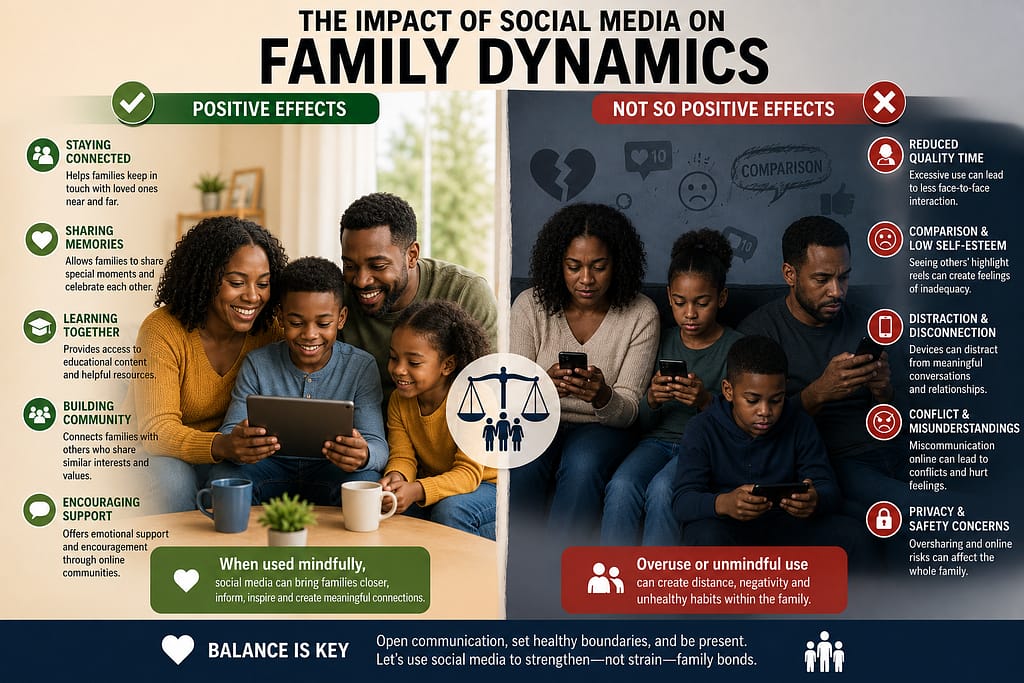
When people hear the words “social media”, they wonder: “How did we live without it? Many individuals think about staying actively involved with social networks. They become overly excited with many “likes”, as it encourages feelings of validation. Sadly, when receiving less “likes” it often causes feelings of self-doubt.
There are many online communities consisting of building profiles and connecting with others to share media or ideas. These platforms are used for various motives, and for a variety of reasons. Most popular is Facebook, the largest global social network connecting families, friends and opportunities to join interest groups. Instagram provides a visual platform mainly sharing photos and short-form videos. Also, there’s X, formerly Twitter, the microblogging network offering users a short broadcast platform for messages, news and opinions. On the entertainment and creator side, there are available networks, including TikTok and YouTube, that tend to consume one’s time. I cannot attempt to mention all the online games.
Considering, such advanced technology and how beneficial it has been across many industries, to name a few, including healthcare, finance, manufacturing, construction, and transportation. One cannot overlook the cost it is having on the family dynamics.
Family dynamics can be defined as the pattern of interactions. This includes how family organizes their day, traditions, and established expected behaviors. It involves family roles, for example, the hero or golden child, the scapegoat, the clown, the lost child, the peace maker, the enabler, and the parentified child. Communication styles are also an important factor in family dynamics. Considering the article in Darcy Baily & Associates Counseling as it identifies four types of family communication patterns:
Consensual – the first type, described as high conversational and high conformity, and the parents are the decision-makers.
Pluralistic – the second style, characterized by high conversational and low conformity. Parents encourage open and honest conversation, and the entire family participates in decision-making.
Protective – the third communication pattern is observed to be low conversational and high conformity. There is less emphasis on conversation and more of an emphasis on obedience. It is understood that decision-making is left up to the parents, and the parents do not provide explanation.
Laissez-faire – the fourth family communication pattern, described as having low conversation and low conformity, the children have their own views and beliefs.
Also, the parents and children will make their own decisions.
In essence, patterns of interactions, roles, and communication patterns dictate how family members connect with each other, and how they function as a unit. Since the inception of social media platforms, there have been noticeable changes within the core values of family dynamics. This consists of the cultivation of a secure, supportive, and stable environment where family members experience and build mutual trust, empathy, and a sense of belonging.
Today, the infiltration of social media due to advanced technology has made an impact on family dynamics, as it is a known fact that the way families organize their day, their traditions, and established expected behaviors have changed. I would argue that social media has contributed largely, but not solely, to such downward changes in the family unit.
Comparing the 60’s 70’s, 80’s 90’s and the 2000’s, family norms provide sight into the challenges social media has presented. The 1960’s family is noted as the decade of transitioning and shifting to a less strict, patriarchal family to a more diverse. Accompanying this shift was the feminist movement, inspiring women to seek higher education and employment.
During this time, childhood was immersed by independence and unsupervised play, with youth roaming the neighborhoods riding bicycles. The 1970s’ family life continued to be centered around togetherness as it was an established norm for families to eat dinner together and share television shows. Routine days consisted of kids out playing in the streets, throwing balls, playing football, softball, and returning home when the streetlights came on.
Considering an article in YourTango (https://www.yourtango.com), as it shares interesting facts about children in the 60’s and 70’s without the influence of social media. The article is titled “9 Reasons People Raised in the 60’s and 70’s Were The Last Kids With A Beautiful Childhood Only They Controlled”, author Mary-Fath Martinez, written on May 01, 2026. The 9 reasons include:
- They didn’t have social media
- They were self-reliant
- They weren’t supervised as closely
- They didn’t know what everyone else was doing
- They had to entertain themselves
- They didn’t have to worry about comparison culture as much
- Their lives didn’t revolve around their accomplishments
- They followed trends differently, and
- Their schedules weren’t so strict and busy.
I am sharing the author’s expressions on 3 of the 9 reasons as they speak more to social media relating to the influence on children.
Reason 1, “They didn’t have social media”. The author stated, “Kids weren’t worried about how many likes or followers they had, and they weren’t trying to emulate the biggest influencers.” She also pointed out that kids had few options for screen time and there wasn’t a concern about kids having too much. She explained that often kids join social media websites before the recommended age. However, she gives credit to one benefit, stating that social media provides communities to which kids can relate, but not without risks. The author mentions social media use is linked to increased depression in kids, and for more information, she provides a link to an article in John Hopkins Medicine, entitled “Social Media and Mental Health in Children and Teens”.
Reason 4, “They didn’t know what everyone else was doing.” The author explains that people are sharing too much of their lives on social media, and podcasts have no limits regarding the topics they discuss. She says, “It feels like you actually know people who are nothing more than perfect strangers.” She asserts that kids in the 60’s and 70’s were not frequently aware of everyone else’s personal affairs, and comparing it to themselves, concluding that everyone is better off, and this impacts one’s self-esteem.
Reason 6, “They didn’t have to worry about comparison culture as much.” The author included a 2020 study from the National Library of Medicine titled, “Social comparisons: A potential mechanism linking problematic social media use with depression.” She confirms that harmful psychological effects can occur from using social media as a gauge to compare one’s life to others, and kids raised in the 60’ and 70’s did not have to contend with this.
The 1980’s family life continued to center around shared meals, watching television together, and the Friday night renting of Blockbuster Videos. The 80’s kids enjoyed a blend of self-directed outdoor physical play. While pre-digital domestic life began generating, paper documents, landline telephones, and analog entertainment began circulating.
The 1990’s family life continued with free-range outdoor play for children; this was the transitional era of low-tech gadgets and media-driven fads. Families continued watching the evening news or renting movies, and they shared single corded landlines phones.
Gathering information from an article in YourTango Revolutionizing Your Relationships, entitled, “11 Reasons 80s & 90s Kids Had Way More Grit & Determination Than Children Today.” This article shares important information regarding instant gratification impact of the development of kids. It confirms that 80’s and 90’s kids did not have information so easily accessible as kids today. Consequently, they learned the importance of having patience, and the true value of waiting. This allowed them to acquire skills of working towards accomplishing tasks without expecting or seeing immediate results. Kids of the 80’s and 90’s had the opportunity to develop delayed gratification, and research confirms that kids who lack delayed gratification do not perform as well as those who do. It supports that kids who learn delayed gratification are better at self-regulation, and perseverance.
Family life in the Millennium experienced multiple changes in households and a shift in technology. Changes in households included an increase in dual-income, cohabiting, and single-parent homes. A major shift in technology where reliance on landline phones, scheduled television shows, and physical media was replaced with early broadband, dial-up internet, and DVDs. Kids in the early 2000s spent hours playing outside, while there was a transition phase to instant messaging, digital music like iPods, and online games on websites. Outdoors activities kept children somewhat disconnected from constant digital immersion.
2010 is marked by a drastic change in what was called the traditional married couple with children to blended stepfamilies, unmarried cohabitating couples raising children, and multi-generational households. According to some research, social media was shifting from college-only platforms into mainstream family life. During this time, Facebook was not heavily saturated by widespread advertising or curated content. Technology shifted towards mobile computing, high-speed connectivity, and advances included Apple iPad, and Android smartphones.
The Alliance Healthcare Foundation, December 12, 2024, article on the national movement to restore healthy childhood confirms that, “Major depressive episodes among American teens have more than doubled since 2010 as their social lives moved onto smartphones loaded with social media apps.” It states that the only available explanation regarding this in the United States and in many countries is that the “play-based childhood” has been replaced by the “phone-based childhood”.
2020 family life was greatly impacted and transformed by the COVID-19 pandemic. The experience with lockdowns caused a disturbing increase in mental health. It ushered in a transition to remote work and distant learning. Parents struggled to balance homeschooling, loss of childcare, health decline within the family and the loss of family members and friends. Technology played a crucial role as it provided a variety of digital healthcare options, including telehealth, smartphone health apps.
According to research from Scientific Reports, article published February 27, 2025, entitled, “Effects of COVID-19 related social media use on well-being”, the pandemic caused a significant surge in global messaging as it is reported that there was a 50% increase during the lockdowns. During the time social media bridged social distancing, however it increased misinformation and information overload, sparking debates over digital screen fatigue and mental health.
The National University published an interesting article on May 1, 2017, entitled, “The Dangers of Social Media on Marriage and Family”. It reports that:
“Social media poses measurable risks to marriages and families through compulsive distraction, distorted comparison, and increased exposure to infidelity risk, with research showing these effects are strongest when social media use displaces face-to-face quality time and is perceived as prioritized over the relationship.“
It shares that there are studies linking the use of social media to marital dissatisfaction. The article confirms that there are three primary mechanisms that play a vital role in reducing relationship satisfaction, including phone-snubbing during conversations, as it indicates disengagement and it deteriorates emotional validation. Destructive social comparison is another mechanism; this happens when individuals in a relationship take for face value the curated highlights reels that portray other relationships as more successful or romantic. Lowered barriers to emotional infidelity are identified as the third mechanism, as reconnecting with an ex-partner is easy to do, and private messaging with new contact is at one’s fingertip.
Social media has impacted and influenced changes within the family dynamics, as it presents additional challenges with communication, it reduces meaningful face-to-face interactions, and it is problematic for emotional connection – not to mention addictions – referring to Evolve Psychiatry Blog, April 1, 2026, entitled, “Is Social Media Addiction Taking Over Your Family Life? The Hidden Role of Family Therapy in Breaking the Cycle.” The article mentions that a family gathers after a long day. They are in the same room, physically present, but emotionally distant. Each person is involved in social media, either scrolling through short videos, replying to messages, or are lost in endless feeds. The blog states: “Over time, this pattern slowly becomes routine. Conversations become shorter and less meaningful. Eye contact reduces.” It expresses that small misunderstandings start turning into frequent arguments. Consequently, family members may start to feel alienated.
Referencing the National Library of Medicine, PubMed Central, Cureus. 2024 Oct 27;16(10):e72499. doi: 10.7759/cureus.72499 abstract, titled, “Understanding Social Media Addiction: A Deep Dive.” The abstract confirms that social media has become an important part of everyday life. It is appealing as it offers instant entertainment, information, and connectivity. However, for some individuals having this access transforms into an addiction. It explains social media addiction, stating:
“Social media addiction is characterized by excessive and compulsive usage that affects daily functioning and overall well-being. It encompasses more than just spending an excessive amount of time online; it involves compulsively checking for updates, feeling anxious when offline, and suffering from negative impacts on real-life relationships and responsibilities.”
It is my opinion that society will continue to experience advances in technology that will impact social media and the lives of families. However, if parents and lawmakers become more aggressive in managing and balancing social media, this can prevent continued adverse effects on families.
[Francine Akins-Arbuckle is a Licensed Professional Counselor, located in Mesa, Arizona, and author of the recommended books, Overcoming Distractions – Biblical Guide To Stay In Focus (available on Amazon) and Living Without A Build-Up (available soon).]